| your question. The test we did was as you described - it was a comparison between the stock piping w/Stillen SMICs vs. the 2.5" piping and MASSIVE SMICs. Not to disregard your question by any means here - this question has been the root of so much debate surrounding this product. The only thing I can say, of which I do have data to fully back up, is that when upgrading to the 2.5" intake piping and the MASSIVE SMICs, you can expect the same gains seen in the testing. Although I can't tell you what the performance benefit is for these items by themselves, my intentions from the get-go was to develop a kit consisting of both the 2.5" piping and the MASSIVE SMICs with 2.5" inlets and outlets. It made no sense to me to expend the time and resources to develop a larger set of intercoolers with 2.0" inlets and outlets when I could upgrade the pipes, intercooler cores, and use 2.5" IO on the ICs. Consider this for a moment: for years everyone felt that 2.5" exhaust was sufficient... and then now it is commonplace to use 3.0" exhaust on high-performance builds. Exhaust pipes handle gases that are moving out of the engine, which had to go through the intake pipes to get into the engine in the first place. Interestingly enough, in a conversation with Greg Dupree last night, we discussed this very thing. He did his own research not long ago and his calcs showed that the stock 2.0" piping is just barely enough for stock turbos. Moving these volumes of relatively dense, cool gases at the velocities seen through a 2.0" pipe stack up enough to produce losses worthy of attention. The MASSIVE intercoolers are built using cores that flow 776CFM each in their bare format. The addition of the endtanks with 2.5" inlets and outlets drop that value down to 326CFM. The charge face area is significantly larger than the area of a 2.5" pipe so this shows that the #1 bottleneck in an intercooler is going to be the area of the inlet and outlet pipes. If a 2.0" inlet and outlet were used, the flowrates of these intercoolers would be reduced quite a bit. It just doesn't make sense to use such a high capacity intercooler and then bottleneck it down with such small diameter pipe when it is so apparent that the diameter of pipe plays a large role. From my calcs, at 400CFM, 1.85" i.d., 14psi inlet pressure, through a 12-foot section of straight pipe produces a pressure drop of 1.55psi. A 2.5" diameter pipe of 2.37" i.d., same length, flow, and inlet pressure will only have a pressure drop of 0.45psi. 20psi, 500CFM
2" pipe: 1.64psi pressure drop
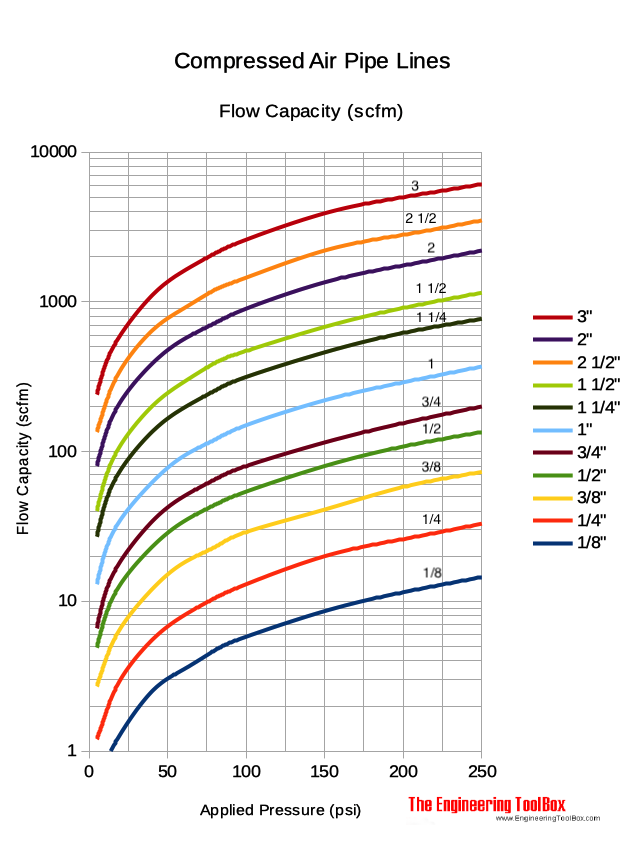
2.5" pipe: 0.48psi pressure drop Given that these numbers are based on calcs performed on a completely straight section of pipe, and that the stock piping is a bit more convoluted than the 2.5" piping, the numbers that represent the actual pipes in the car are going to have even greater difference than this theoretical value. At the same applied pressure, there is what appears to me as about a 100SCFM+ difference between a 2.0" pipe and 2.5" pipe. That's a pretty appreciable difference in flow volume.

[ ashspecz.com ]
[ agpowers@bellsouth.net ] Enthusiasts soon understand each other. --W. Irving.
Are you an enthusiast? If you are out to describe the truth, leave elegance to the tailor.
Albert Einstein
|


